
Rusutsu Resort
Four services, one connected project.
Strategy, research and monitoring, community learning and communication. A water-cycle project developed since 2024 by combining all four services.
View the timeline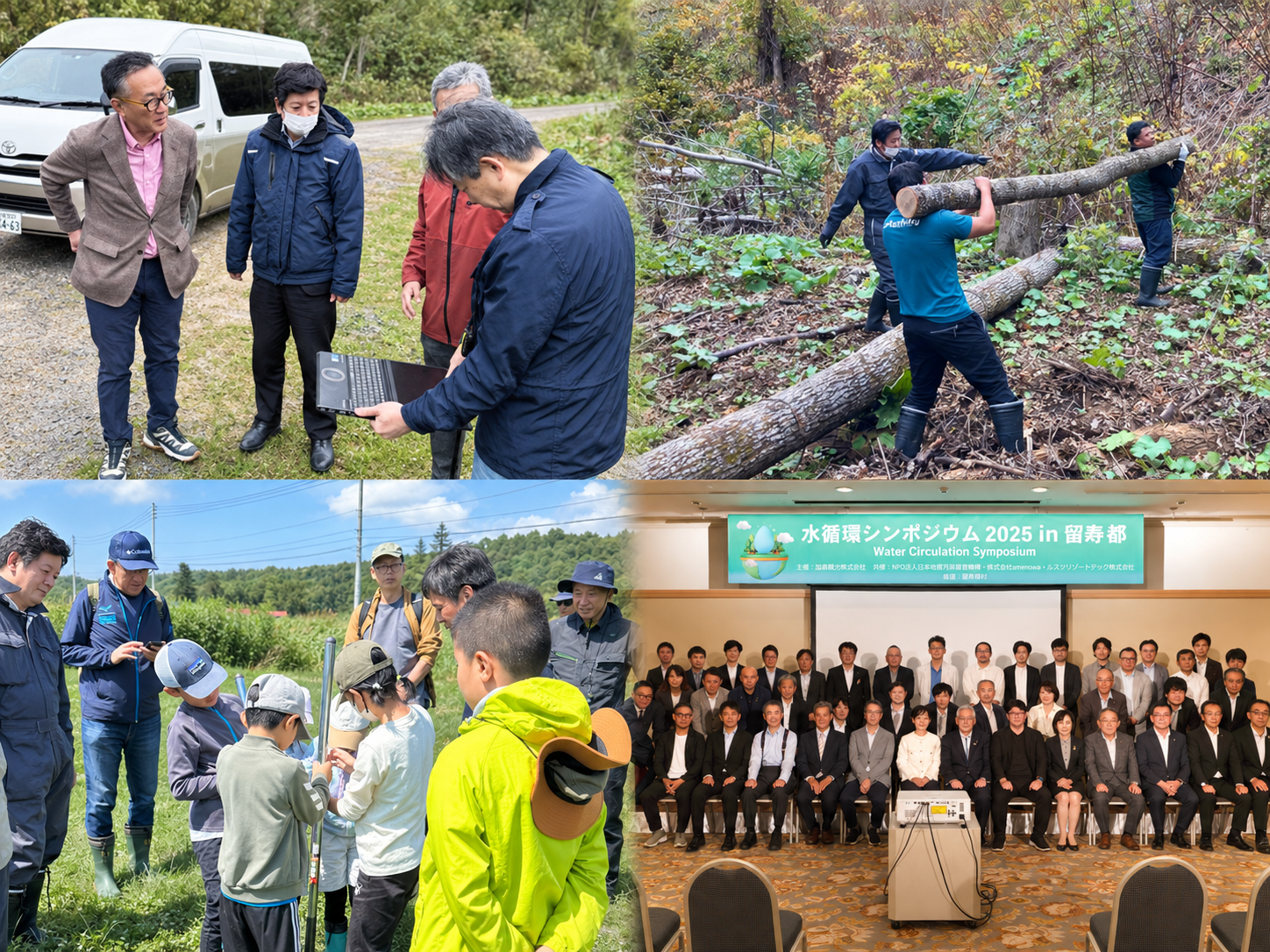
Rusutsu Resort’s water-cycle project did not begin with a single measure.
Develop a strategy.
Investigate and measure nature.
Learn and act with the community.
Share that value with society.
Since 2024, we have developed the project step by step by combining amenowa’s four services.
Explore that journey in the timeline below.
Design the whole project around water.
At Rusutsu Resort, we began by recognizing water as vital natural capital for both the region and the resort.
From there, we connected researchers, universities, local government and businesses to design a long-term water-cycle project, progressing through surveys, monitoring, trials, education and communication.
amenowa works with partners to define what to achieve, who to work with and how to create local value, so that environmental measures become more than isolated activities.
Investigate, measure, protect and nurture unseen water.
At Rusutsu, we have walked mountains, forests, rivers, springs and wells with researchers to investigate where water comes from and where it goes.
Monitoring wells, water-level sensors, rain gauges, IoT and LoRaWAN now support continuous observation of groundwater and rainfall.
The project is moving beyond observation to practical measures that protect and nurture water, using natural processes to slow water flows and encourage infiltration through leaky dams and kerplunk structures.
amenowa supports the full process: field surveys → monitoring → data → improvement measures.
Turn research into local learning and action.
At Rusutsu, the water-cycle project is expanding so that local government, communities and children can participate alongside researchers and businesses.
The annual water-cycle symposium, held since 2024, shares each year’s findings and achievements to inform the next stage of work.
Hands-on events also bring local children into forests and rivers to learn about water and nature.
We plan to extend these opportunities to school trips and corporate training, connecting an understanding of nature with community action and learning for the next generation.
Make the value of environmental action understood.
Carrying out environmental activities is only part of the work.
It is also important to explain clearly what we aimed for, what we did and what came from it.
At Rusutsu, surveys, IoT monitoring, forest trials, symposia and children’s events are organized into one story:
Understand water → Measure → Protect and nurture → Connect with the community
We share that story through websites, articles, photographs, video and events.
amenowa helps turn worthwhile activities into value that businesses and communities can communicate.
Rusutsu Resort water-cycle project timeline
Explore how the four services came together and the project developed from 2024 to 2026.
22 initiatives
2024
Understand
Position water as local natural capital and develop the project vision.
Early year–summer
- 01 Strategy & design
Developing the vision for a project centered on the water cycle
Toward the symposium and field surveys
September
- 02 Research & implementation
Field visits to water sources, mountains, forests and surrounding areas
Toward hydrogeological surveys and monitoring design
- 03 Community Collaboration & Environmental Education
First Water Circulation Symposium in Rusutsu
From discussion to investigation
Later in the year
- 01 Strategy & design
Planning to understand water levels, rainfall and wells through data
Toward IoT monitoring
2025
Monitor
Use field surveys and IoT monitoring to understand where water comes from and where it goes.
May–summer
- 02 Research & implementation
Hydrogeological, groundwater, spring and forest surveys
Toward monitoring-site and sensor design
- 02 Research & implementation
Designing monitoring wells, water-level sensors, rain gauges and LoRaWAN
Toward Phase 1
September
- 02 Research & implementation
Phase 1: Building the IoT monitoring infrastructure
Toward continuous monitoring and data collection
- 03 Community Collaboration & Environmental Education
Second Water Circulation Symposium and field tour
Toward green infrastructure and local implementation
Autumn–winter
- 02 Research & implementation
Installing leaky dams
From measurement to protection and restoration
- 02 Research & implementation
Maintaining IoT operation through heavy snow and low temperatures
Toward system redesign
2026
Protect, nurture and connect
Use monitoring data to expand into forest and green infrastructure implementation, joint research, education and local partnerships.
May
- 02 Research & implementation
Phase 1.5: Reviewing winter challenges and redesigning the system (May 7–10)
Toward full implementation
- 02 Research & implementation
Confirming springs and installing a simple monitoring well in Udo Valley, upper EAST
Expanding the monitoring area
- 02 Research & implementation
Considering the introduction of kerplunk structures
Toward research trials with universities
July
- 01 Strategy & design
Joint research with the Prefectural University of Kumamoto COI-NEXT, Nagoya Institute of Technology and others
Developing a field site for research trials
- 02 Research & implementation
Phase 2: Expanding monitoring equipment and IoT infrastructure
From individual points to area-wide monitoring
- 02 Research & implementation
Well surveys in EAST, Izumikawa and WEST
Deepening understanding of the water-cycle structure
- 02 Research & implementation
Testing IoT integration of existing water-level sensors
Toward continuous monitoring with less manual work
- 02 Research & implementation
Connecting rainfall and groundwater data to the web
Toward AquaInsight-based visualization
Summer–year-round
- 03 Community Collaboration & Environmental Education
Water and nature events for local children
Toward school trips and educational travel
- 03 Community Collaboration & Environmental Education
Designing educational travel programs such as the Water Journey
Creating community and tourism value
- 04 Branding
Communication through NatureLink, articles, photographs and events
Building a sustainable brand
September
- 01 Strategy & design
Third Water Circulation Symposium and collaboration among six partners
Toward the Rusutsu model
Let’s talk about water and nature.
Together.
From challenges in the field to ideas for the future.
Tell us what you have in mind.